Google Just Locked Developers Out of Their Accounts—And Claude Found 500 Security Holes No Human Ever Spotted
NotionGoogle's Antigravity Platform Just Became a Minefield
Imagine waking up Monday morning to find your Google account—email, docs, everything—completely locked. Not because you did anything obviously wrong, but because an AI agent you connected to Google's new "vibe coding" platform triggered their ToS enforcement algorithm.
That's exactly what happened to dozens of developers this weekend. Google's new Antigravity platform controversy has the developer community on edge, with users reporting total account lockouts after connecting OpenClaw—an open source autonomous AI agent—to their Google services.

The irony? While Google's cracking down on "malicious usage" with a sledgehammer, Anthropic just proved that our existing codebases are riddled with vulnerabilities that have been hiding in plain sight for decades.
Claude Just Embarrassed Every Security Expert on Earth
Here's the part that should make every CISO lose sleep: Anthropic's Claude Opus 4.6 found over 500 high-severity vulnerabilities in production open-source codebases that survived decades of expert review and millions of hours of fuzzing.
Read that again. Decades. Millions of hours. And an AI found them in 15 days.

Each vulnerability was vetted through internal and external security review before disclosure. This isn't Claude hallucinating threats—these are real, exploitable holes that human experts missed. And now it's a product: Claude Code Security launched just 15 days after the initial discovery.
Think about what this means for the security industry. If AI can outperform collective human expertise by this margin, what's the half-life of traditional security auditing?
When AI Codes Faster Than Humans Can Review
But here's where things get really interesting: if AI can find vulnerabilities this effectively, it can also write code faster than any human team. Treasure Data just proved it when one engineer built a production SaaS product in an hour.
One. Hour. Production-ready.
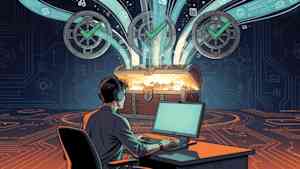
The company, which serves 450+ global brands, officially announced Treasure Code—their answer to the governance question that's keeping every engineering leader up at night: What does oversight look like when humans aren't writing the code anymore?
Here's the governance paradox we're facing:
Traditional Development:
Human writes code → Human reviews code → Deploy
(Slow, but clear accountability)
AI-Assisted Development:
AI writes code → Human reviews ??? → Deploy faster
(Who's responsible when AI generates vulnerabilities?)
Future State:
AI writes code → AI finds vulnerabilities → AI fixes → Human ???
(What's left for humans to do?)
The ToS Trap Nobody Saw Coming
Back to Google's crackdown: this is the canary in the coal mine for AI-assisted development. When you're using autonomous agents that connect to platform APIs, you're one algorithmic decision away from losing access to critical infrastructure.
The developers locked out of their Google accounts weren't necessarily doing anything malicious. They were experimenting with autonomous agents—the exact kind of innovation that every tech company claims to encourage. Until it triggers an automated enforcement system.
What's the lesson here? In the age of AI agents, platform ToS enforcement becomes an existential risk.
The Real Story Everyone's Missing
While headlines scream about Anthropic fighting the Pentagon over "any lawful use" language for lethal autonomous weapons, the real transformation is happening in your engineering organization right now.
We're watching three simultaneous disruptions:
- AI can find security holes humans miss (Claude's 500+ vulnerabilities)
- AI can write production code faster than teams can govern it (Treasure Data's 1-hour SaaS product)
- Platform ToS enforcement is becoming an automated minefield (Google's Antigravity lockouts) The companies that figure out governance frameworks for AI-generated code in the next 6 months will have an insurmountable advantage. The ones that don't? They'll either move too slowly to compete or move too fast and end up locked out of critical platforms.
So What Happens Next?
Here's my hot take: We're about to see a wave of "AI governance consultants" emerge as fast as we saw "cloud migration specialists" a decade ago. Because the current state—autonomous agents writing code faster than humans can review it, finding vulnerabilities humans can't spot, while platform providers panic and lock accounts—is completely unsustainable.
The question isn't whether your team will adopt AI coding agents. It's whether you'll have governance frameworks in place before your competitors do—or before a platform provider decides your usage looks "malicious."
Are you building those frameworks now, or are you waiting until someone on your team gets locked out of their Google account to start caring?
Share this post
Help this article travel further
One tap opens the share sheet or pre-fills the post for the platform you want.