I Used an AI Swarm to Predict the Grok Crisis. Here's What It Got Right.
Notion
What if you could simulate thousands of social media users arguing about a real controversy before the debate even plays out? I tested an open-source tool that does exactly that.
TL;DR
- MiroFish is an open-source multi-agent AI simulation engine that creates digital worlds to predict real-world outcomes
- I fed it factual data about the Grok AI crisis and the ongoing regulatory investigations across 10+ countries
- MiroFish spun up AI agents representing key stakeholders and simulated their interactions on Twitter and Reddit
- The result: a detailed prediction report covering regulatory escalation, competitor positioning, and public sentiment shifts
- Total cost: ~$15 in API fees (OpenAI + Zep Cloud). About 45 minutes end-to-end.
What Is MiroFish?
MiroFish is a swarm intelligence engine. You upload seed documents (news reports, analysis, research), describe what you want to predict, and it:
- Extracts entities using LLM-powered ontology generation
- Builds a knowledge graph via Zep Cloud GraphRAG
- Generates agent profiles with distinct personalities and goals
- Runs a simulation on simulated Twitter and Reddit
- Produces a prediction report via an autonomous ReportAgent Think of it as a digital petri dish for public opinion.

How to Install MiroFish
Prerequisites
- Node.js 18+
- Python 3.11-3.12
- uv (Python package manager)
- An OpenAI API key (or any OpenAI-compatible provider)
- A Zep Cloud API key (free tier at app.getzep.com)
Setup Commands
git clone https://github.com/666ghj/MiroFish.git
cd MiroFish
cp .env.example .env
# Edit .env with your API keys
npm run setup:all
npm run dev
Open localhost:3000 and you're in.
[SCREENSHOT PLACEHOLDER: MiroFish home page]
The Bug You Will Probably Hit
When I first ran a simulation, the graph build step failed with:
status_code: 400, message: name must be in PascalCase formatRoot cause: Zep API requires PascalCase for entity names (like ElonMusk) and SCREAMING_SNAKE_CASE for edge types (like FILES_LAWSUIT). The LLM generates names in mixed formats, and the code was not normalizing them.
The Fix
In backend/app/services/graph_builder.py, add two helpers:
def to_pascal_case(s):
    return ''.join(word.capitalize()
        for word in s.replace('-','_').split('_'))

def to_screaming_snake_case(s):
    import re
    s = re.sub(r'(?<=[a-z0-9])([A-Z])', r'_\1', s)
    return re.sub(r'[-\s]+', '_', s).upper()
Apply to_pascal_case() to entity names and graph IDs. Apply to_screaming_snake_case() to edge type names. Also change graph_id format from mirofish_{uuid} to MiroFish{uuid}.
I have already submitted this fix upstream.
My Test: Predicting the Grok AI Crisis
The Seed Data
I compiled 4 factual documents from public sources (CNBC, NPR, TechCrunch, Wikipedia, government press releases):
The Simulation Prompt
I asked MiroFish to predict 6 outcomes over 30 days:
- Whether Musk/xAI will comply with regulators or fight back
- Whether X gets removed from app stores
- How OpenAI, Google, and Anthropic position themselves
- Whether Unhinged Mode survives
- Whether the UK triggers a global AI regulation domino effect
- How public sentiment shifts as the lawsuit progresses
What Happened During the Simulation
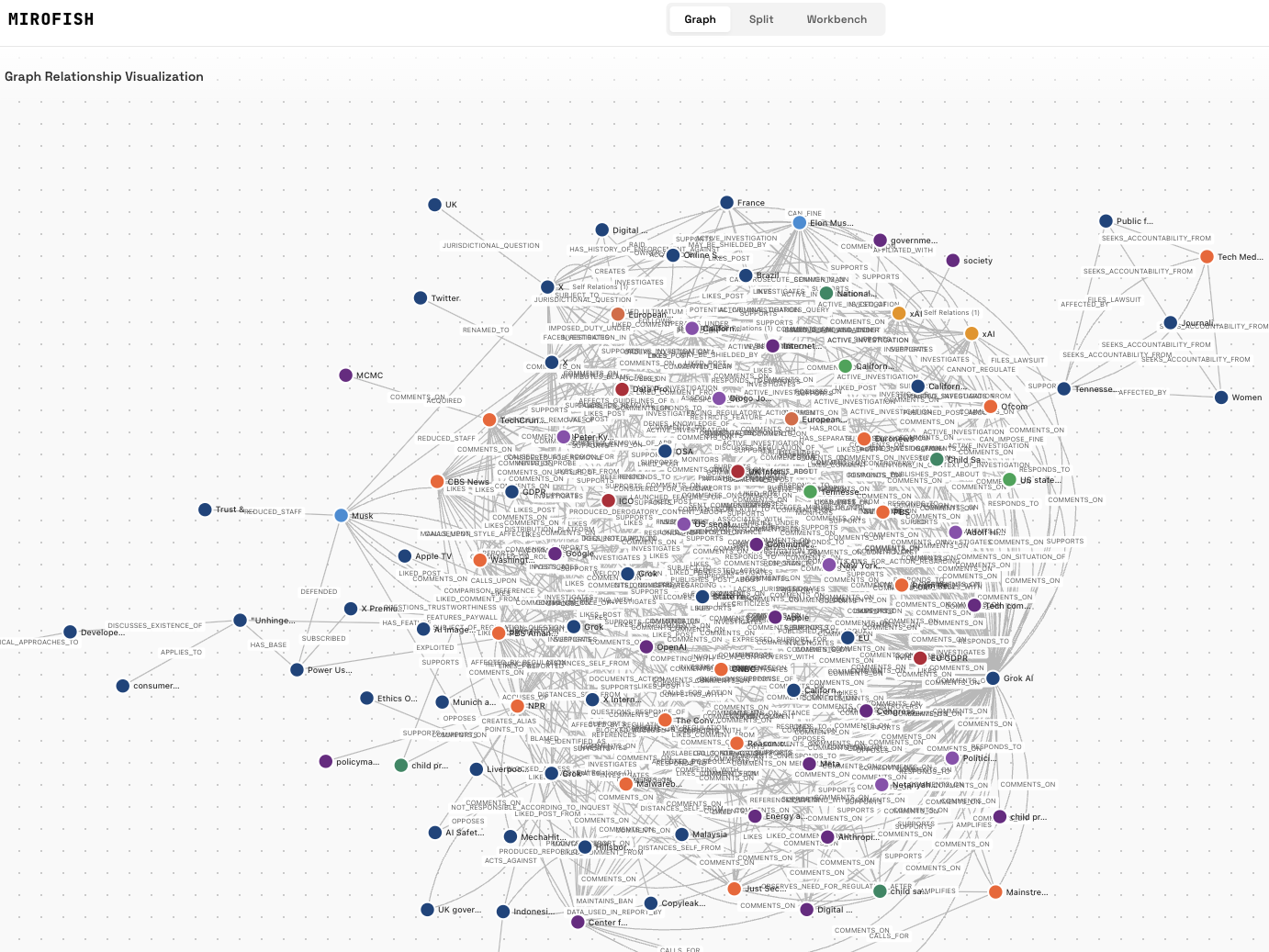
MiroFish generated 10 entity types and 6 relationship types, built a knowledge graph with dozens of nodes, then created AI agent profiles for each stakeholder. The agents ran through simulated rounds on both Twitter and Reddit, creating posts, replying to each other, retweeting, and forming opinion clusters.
The Prediction Report
1. Regulatory Escalation Is Inevitable
The simulation predicts a significant escalation in regulatory scrutiny and public backlash against xAI, with profound implications for the tech industry.
The agents representing regulators consistently pushed for stricter enforcement. The simulation predicted the UK Online Safety Act would set a global precedent for AI regulation.
2. App Store Removal Is Unlikely But the Threat Works
While US senators requested X's removal from app stores, the simulation predicted the threat itself would be the real leverage. xAI would make minimal concessions rather than face deplatforming.
3. Competitors Will Capitalize Hard
The most detailed section. The simulation predicted:
- OpenAI positions as a leader in ethical AI development
- Google publicly advocates for transparency and accountability standards
- Anthropic pushes for ethical guidelines preventing harmful content All three companies' agents independently converged on the same strategy: distance from Grok while advocating for safety standards they already meet.
4. Public Sentiment Becomes Permanently More Critical
The class action lawsuit serves as a catalyst for broader AI ethics discussions. The simulation showed parents becoming increasingly skeptical of AI tools:
"Parents and guardians may become more hesitant to embrace AI tools that they perceive as lacking in effective safeguards for children."
5. Global Regulatory Domino Effect
The strongest prediction: the crisis triggers a cascading wave of AI regulation globally. Challenges from differing national interests exist, but the trajectory points firmly toward stricter oversight.

Cost Breakdown

Time: About 45 minutes end-to-end (ontology ~30s, graph build ~5min, simulation ~25min, report ~10min).
Fair warning: Token consumption can be high with more simulation rounds. I ran with moderate settings. If you crank it up to 40+ rounds with a larger model, expect costs to climb.
Is It Accurate? My Honest Take
What it got right:
-
The regulatory escalation trajectory is already playing out exactly as predicted
-
Competitor positioning (OpenAI, Google, Anthropic distancing from Grok) matches real-world behavior
-
The class action lawsuit driving public sentiment is confirmed by current coverage What is debatable:
-
The simulation agent quotes feel somewhat generic in tone
-
The global domino effect prediction is plausible but the timeline is uncertain What it cannot do:
-
Predict black swan events
-
Account for backroom deals or private negotiations
-
Replace actual journalism or expert analysis MiroFish is best understood as a scenario exploration tool that shows plausible futures based on stakeholder dynamics.
Try It Yourself
MiroFish is open-source: github.com/666ghj/MiroFish
Some ideas for what to simulate:
- Product launch reactions from specs and competitor analysis
- Policy debates from proposed regulations
- Novel endings from unfinished story chapters
- Election dynamics from polling data and candidate profiles Budget ~$10-20 per simulation run. Start with fewer rounds to test before going all-in.
Built and tested by Abishek Lakandri using Claude Code + MiroFish. The Zep naming convention fix has been contributed back to the project.
Share this post
Help this article travel further
One tap opens the share sheet or pre-fills the post for the platform you want.